
Your SaaS Product Is Not Special Anymore
A teenager with Claude Code can build what took your engineering team six months. A non-technical founder with Cursor and a weekend of free time can ship a competitor to your product by Monday morning. Your own customers are starting to wonder why they are paying you when they could just build it themselves.
This is not a hypothetical. It is happening right now.
Tools like Claude Code, Codex, Cursor, and Lovable have collapsed the barrier to building software. The result is a flood of new SaaS products launching in every category, every day. Most of them are mediocre. But some of them are good. And a few of them are targeting your exact market with a cheaper price and a fresher brand.
Here is the uncomfortable truth: your product is not your moat anymore. Code is easy to replicate. Features get copied in days, sometimes hours. The only thing that cannot be cloned overnight is a brand that people know, trust, and choose over the 15 alternatives they saw people giving away on Twitter and LinkedIn this morning.
That means your SaaS marketing strategy is no longer a nice-to-have. It is the thing that determines whether your company survives the next two years.
But most founders are getting this wrong in one of two ways.
Some avoid marketing altogether. They believe their product is good enough to sell itself. This almost never works. Even companies like Apple and Basecamp, which seem to grow on product quality alone, are actually running sophisticated marketing. It just looks invisible because they are so good at it.
Other founders try to outsource everything too early. They hand off their entire marketing strategy to a freelancer or agency before they even understand their own customers. This fails too, because no one knows the product, the market, or the buyer as well as the founder does.
The founders who win do something different. They own the strategy and partner on the execution. They stay close enough to the customer to know exactly what messaging will land. They decide which channels to invest in and know how to tell whether those channels are working. And then they bring in the right people to actually run the campaigns, write the content, and manage the ads.
That split between strategic ownership and execution is what this guide is built around. By the end, you will have a step-by-step SaaS marketing plan you can start acting on today.
What Goes Into a Winning SaaS Marketing Strategy?
This is not a list of generic tactics. It is a complete B2B SaaS marketing strategy built around the frameworks, metrics, and decision-making tools that actually drive growth in 2026.
- Voice-of-customer research as the foundation for all positioning, messaging, and product decisions
- Funnel selection (high-touch, low-touch, or dual) based on your pricing and buyer type
- Funnel diagnostics to fix conversion, onboarding, and churn problems before you scale spend
- Channel selection using the SCS Litmus Test (Speed, Cost, Scalability) mapped to your annual contract value
- Prioritization scoring to rank your marketing approaches and run disciplined experiments
- The six core SaaS metrics you need to track, including CAC, churn, ACV, expansion revenue, and the MRR plateau formula that predicts when your growth will stall
- Scaling principles for doubling down on what works without spreading yourself thin
Whether you are a technical founder figuring out how to market SaaS for the first time or an experienced operator building a B2B SaaS marketing plan for your next stage of growth, this guide gives you the playbook.
Let's start with the one thing no competitor can copy from you: how well you understand your customer.
Step 1: Spend 20% of Your Time Talking to Customers
Most SaaS founders have never had a real conversation with someone who canceled their product. Think about that. They are losing customers every month and they have no idea why. They are guessing at their marketing copy. They are guessing at their positioning. They are guessing at which features to build next.
And then they wonder why their growth has stalled.
Before you touch channels, funnels, or tactics, you need to build an understanding of your customers that is so deep it becomes unfair. Their exact words. Their real frustrations. The moment they decided to look for a solution. The moment they almost left. This is the foundation of every SaaS marketing strategy that actually works, and everything downstream improves when you truly understand your customers.
Here is how to start.
Talk to four groups of people. Prospects, current customers, people who decided not to buy, and people who bought and then canceled. Most founders only talk to the first two. That is a mistake. The people who rejected you and the people who left you will teach you more about your weaknesses than a hundred happy customer calls.
Ask open-ended questions: What problem are you trying to solve? What tools do you use now? What frustrates you about the current options? Let them talk. Your job is to listen, not pitch.
Record and catalog every sales conversation. If you run a sales-led product and you are not recording your demos, you are letting your most valuable marketing data evaporate. Every demo is full of real customer language, real objections, and real buying triggers. Record these calls. Tag the key moments. Save the exact phrases people use.
This is not just for you. When you eventually bring on a marketing partner or team, this library of real customer language becomes the raw material for messaging, ad copy, landing pages, and content that actually converts. Without it, your marketing team is writing fiction.
Build a voice-of-customer repository. Stop keeping customer insights in your head. Create a shared document with sections for pain points, objections, competitor mentions, "aha moment" language, and cancellation reasons. Update it after every interview and every sales call. Five minutes of notes now saves you months of bad marketing later.
Let VoC drive both product and marketing. When your product team and your marketing team are both pulling from the same customer insight, something powerful happens. Your product gets built for the people you are actually selling to. Your marketing speaks in the exact language those people use. Your positioning and your product are perfectly aligned. And that alignment is the thing that makes SaaS companies genuinely hard to compete with, even when someone can clone your features in a weekend.
Skip this step and everything else in this guide is built on sand.
Action items:
- Schedule five customer or prospect interviews in the next two weeks. Aim for at least one person from each group: a current customer, a prospect, a lost prospect, and a churned customer.
- Set up call recording for all sales demos and discovery calls. Tools like Calendly, Fireflies, or Google Meet's recording feature. The key is to start capturing these conversations now.
- Run the transcripts through ChatGPT, Gemini, or Claude and ask it to pull out key insights and learnings.
- Create a voice-of-customer document (a Google Doc or Notion page works to start). Add four sections: Pain Points, Objections, Competitor Mentions, and Customer Language. After each interview or sales call, spend five minutes adding the highlights.
- Review your current homepage and landing page copy. Does it use the same words your customers use, or does it sound like it was written by someone who has never talked to a buyer? Flag anything that needs to change.
Looking for a SaaS marketing agency that actually understands your metrics?
We build paid media and creative strategies around CAC payback, pipeline value, and activation rate. Not vanity metrics. Book a call and we will show you what we would do differently in your account.
Book a Free SaaS Marketing AuditStep 2: Choose Your Funnel Type
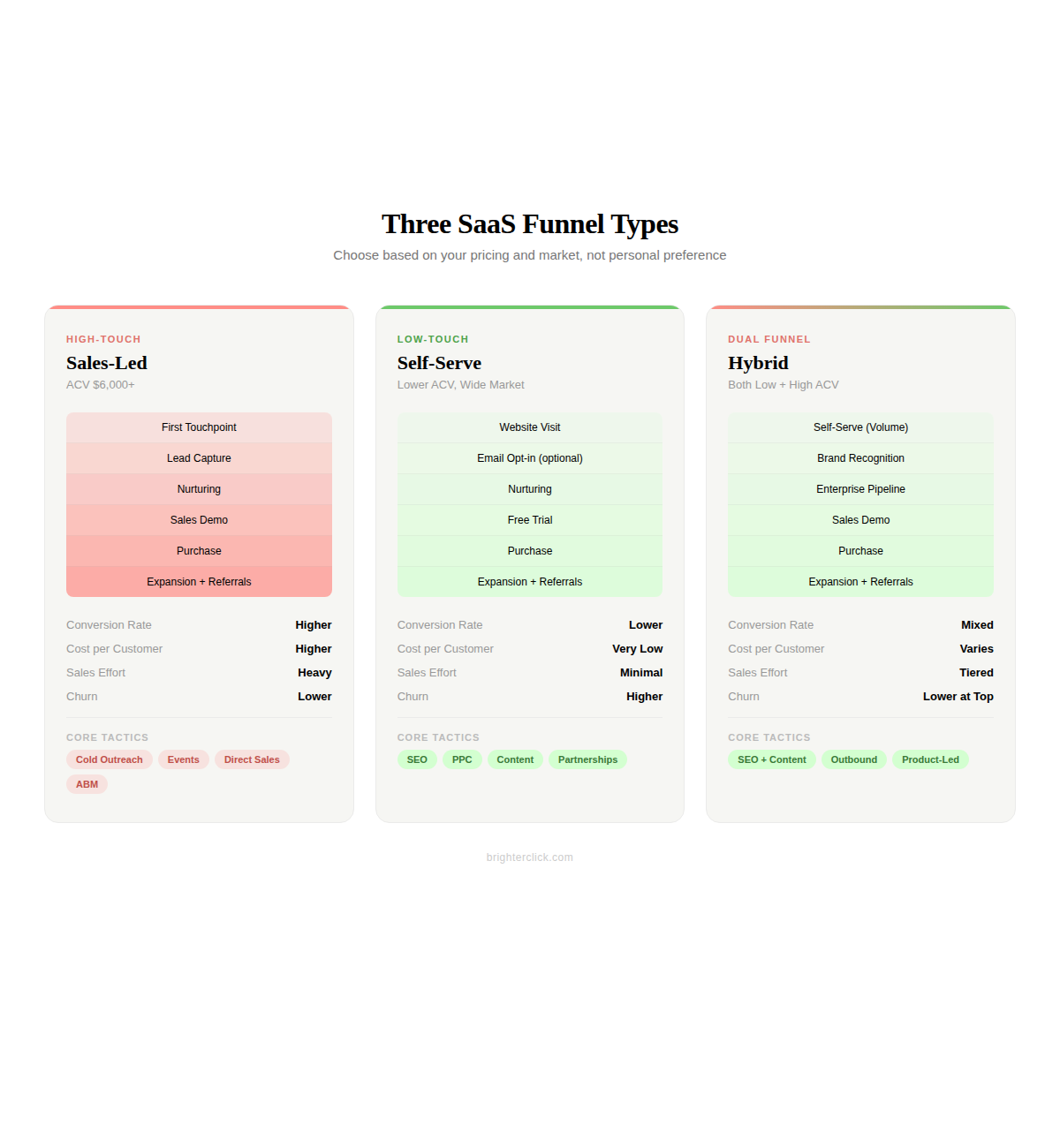
Here is a decision that will either set your SaaS marketing strategy up for success or silently sabotage everything you do: your funnel type. This is the backbone of your go-to-market strategy. It shapes your channels, your team, your budget, and how every dollar gets spent. Get this wrong, and you will spend months pouring effort into tactics that were never designed for your business.
Most founders pick their funnel based on what they personally prefer as a buyer. They hate talking to salespeople, so they build a self-serve funnel. Or they love the idea of high-ticket deals, so they build an enterprise sales motion. Both of these can work. But only if they match your pricing and your market. Personal preference is irrelevant.
There are three funnel types. Choose yours based on the math, not your feelings.
High-touch funnel. This model provides your customers with ample human interaction as they make their buying decisions. A prospect might first hear about you at a trade show or through a cold email. They schedule a demo with a salesperson. If the demo goes well, they sign up and get handed off to a customer success rep for onboarding.
High-touch funnels work best when your annual contract value (ACV) is at least $6,000 ($500 per month). The higher your price, the more hand-holding your buyers expect, and the more you can afford to provide. These funnels rely heavily on outbound tactics such as cold outreach, in-person events, and direct sales.
Low-touch funnel. This product-led growth model works when you have a wide market and a lower-priced product. Prospects find you through search, ads, or content. They sign up for a free trial on their own. After the trial, some percentage converts to paying customers without ever talking to a human on your team.
Low-touch funnels are a volume game. You will see lower conversion rates and higher churn, but your cost to acquire each customer is very low. These funnels rely on inbound marketing tactics like SEO, PPC ads, content marketing, and partnerships.
Dual funnel. This is what some call a SaaS cheat code. You target both a wide audience at a low price point and a premium or enterprise audience at a high price point. The low-touch side brings in volume and builds brand awareness. That brand recognition then feeds the high-touch, high-priced side.
For example, a project management tool might have a self-serve plan at $15 per month for freelancers and small teams who just need task boards and basic collaboration. On the other side, that same tool might offer an enterprise plan for construction firms managing dozens of job sites with complex timelines and compliance requirements. In the early days, the low-touch side drives most revenue and builds name recognition. As the brand grows, the enterprise side becomes a bigger piece of the pie.
Which funnel is right for you? Look at your pricing and your buyer. If you charge $1,000 per month and sell to teams with a procurement process, you need a high-touch funnel. If you charge $29 per month and sell to individual users, you need a low-touch funnel. If your product can serve both, a dual funnel can accelerate growth dramatically.
Action items:
- Write down your current average revenue per account (ARPA). If you do not know this number, log into your billing dashboard and calculate it: total MRR divided by total paying customers.
- Based on your ARPA and buyer type, decide which funnel model fits your business. High-touch, low-touch, or dual. Write it down. This decision will guide every channel and budget choice that follows.
- Map your current customer journey from the first touchpoint to the paying customer. Write out each step. Where do prospects enter? What happens next? Where do they drop off? This does not have to be perfect. A rough sketch on paper or a whiteboard is enough to spot obvious gaps.
- If you are running a high-touch funnel without a documented sales demo script, create one this week. Even a simple outline of the five questions you always ask and the three features you always show will make your demos more consistent and easier to hand off later.
Step 3: Fix the Bottom Before You Fill the Top
Here is a mistake that wastes more marketing budget than almost anything else: pouring money into lead generation while the bottom of your funnel leaks.
Before you scale your marketing spend, make sure the people already entering your funnel are converting and sticking around. Good marketing only makes a bad product fail faster. It drives a bunch of people to something that does not deliver, and you burn through cash with nothing to show for it.
Instead, work from the bottom of your funnel upward.
Are customers churning fast after paying? If people sign up, pay for a month or two, and then cancel, you likely have a product-market fit problem or an onboarding problem. They are not seeing enough value quickly enough. Fix this before you spend another dollar on ads.
Are people trying your product but not converting to paid? If your free trial numbers look healthy but paid conversions are low, something is wrong with your onboarding or sales process. You need to get people to their "aha moment" faster.
Do you have website traffic but nobody is signing up? If people visit your site and leave without starting a trial, the problem is usually your value proposition, your positioning, or your marketing copy. The message is not landing.
Work through these in order. There is no point driving more traffic to a website with weak copy. There is no point improving copy if your trial-to-paid conversion is broken. And there is no point fixing conversion if customers churn out in 60 days anyway.
Use Your Metrics to Find the Real Problem
When you look at a metric like churn, a single number can hide what is actually going on. Saying your gross churn rate is 8% does not tell you enough to act on. You need to break it down.
Segment churn by pricing tier. In almost every SaaS business, lower-paying customers churn faster and higher-paying customers stick around longer. You might find that your $30 per month tier has 11% churn while your $100 per month tier has 2% churn. Those are two completely different problems. One group might be a poor fit for your product. The other might be your ideal customer. Knowing the difference changes how you respond.
Segment churn by marketing channel. This takes a little more setup, but the results can be eye-opening. You might discover that customers who come through PPC ads have much shorter lifetimes than customers who come through organic search or referrals. If one channel is filling your funnel with people who leave quickly, that is not a growth channel. It is a leaky bucket. Understanding this can save you from wasting money on traffic that never sticks.
Segment churn by cohort. Look at when customers are leaving. You will often find that churn is highest in the first 30 to 60 days because people are treating that window as an extended paid trial. They signed up but never fully set up their account or found value.
If most of your churn happens early, the fix is usually better onboarding. Send emails that guide new users to key features. Offer live setup calls for higher-value accounts. Do whatever you can to get people to experience the value of your product before they lose interest and cancel.
If churn is spread evenly across all time periods, the problem is more likely product-market fit. Customers are seeing what you offer, using it for a while, and deciding it is not worth paying for.
Watch Out for Vanity Metrics
As you diagnose your funnel, be careful about which numbers you focus on. It is easy to get excited about 50,000 monthly website visitors, 100 new free sign-ups per week, or 25,000 email subscribers. Those numbers sound impressive until you dig deeper.
How many of those visitors convert to trials? How many trials become paying customers? What is the open rate on that email list? Metrics like page views, free users, and subscriber counts are only meaningful in context. The real question is always: how many of these people are turning into paying customers who stick around?
Once the bottom of your funnel is solid, every dollar you spend at the top works harder.
Action items:
- Pull your churn rate for the last three months. If it is above 5% gross revenue churn monthly, stop all plans to increase top-of-funnel spend until you understand why people are leaving.
- Break your churn down by pricing tier. If your lowest tier has significantly higher churn than your other tiers, investigate whether those customers are a poor fit or whether they need a different onboarding experience.
- Check when customers are leaving. If most cancellations happen in the first 30 to 60 days, your onboarding is the most likely problem. If churn is spread evenly, look more closely at product-market fit.
- Calculate your trial-to-paid conversion rate. If you do not have this number, set up tracking this week. You cannot improve what you do not measure.
- Check your website analytics for your main landing pages. What is the bounce rate? What percentage of visitors start a trial or request a demo? If fewer than 2% of visitors take action, your messaging needs work before you drive more traffic.
- Send a short email to your five most recent cancellations asking why they left. Keep it simple: "We noticed you canceled recently. Would you mind sharing what was not working for you? Even a one-sentence reply helps." The answers will tell you exactly what to fix.
- Audit your dashboard for vanity metrics. If you are reporting on page views, free sign-ups, or email subscribers without connecting them to paid conversions, add that connection this week. Every metric should trace back to revenue.
- Write down your three funnel metrics (churn rate, trial-to-paid rate, visitor-to-trial rate) and set a reminder to check them monthly.
Step 4: Filter Channels with the SCS Litmus Test
Here is what most SaaS marketing guides do at this point. They list every marketing channel that exists, describe each one in a paragraph, and leave you more overwhelmed than when you started.
That is useless. You do not need to know every channel. You need to know which ones are worth your time and money right now, given your specific price point and stage. Everything else is a distraction.
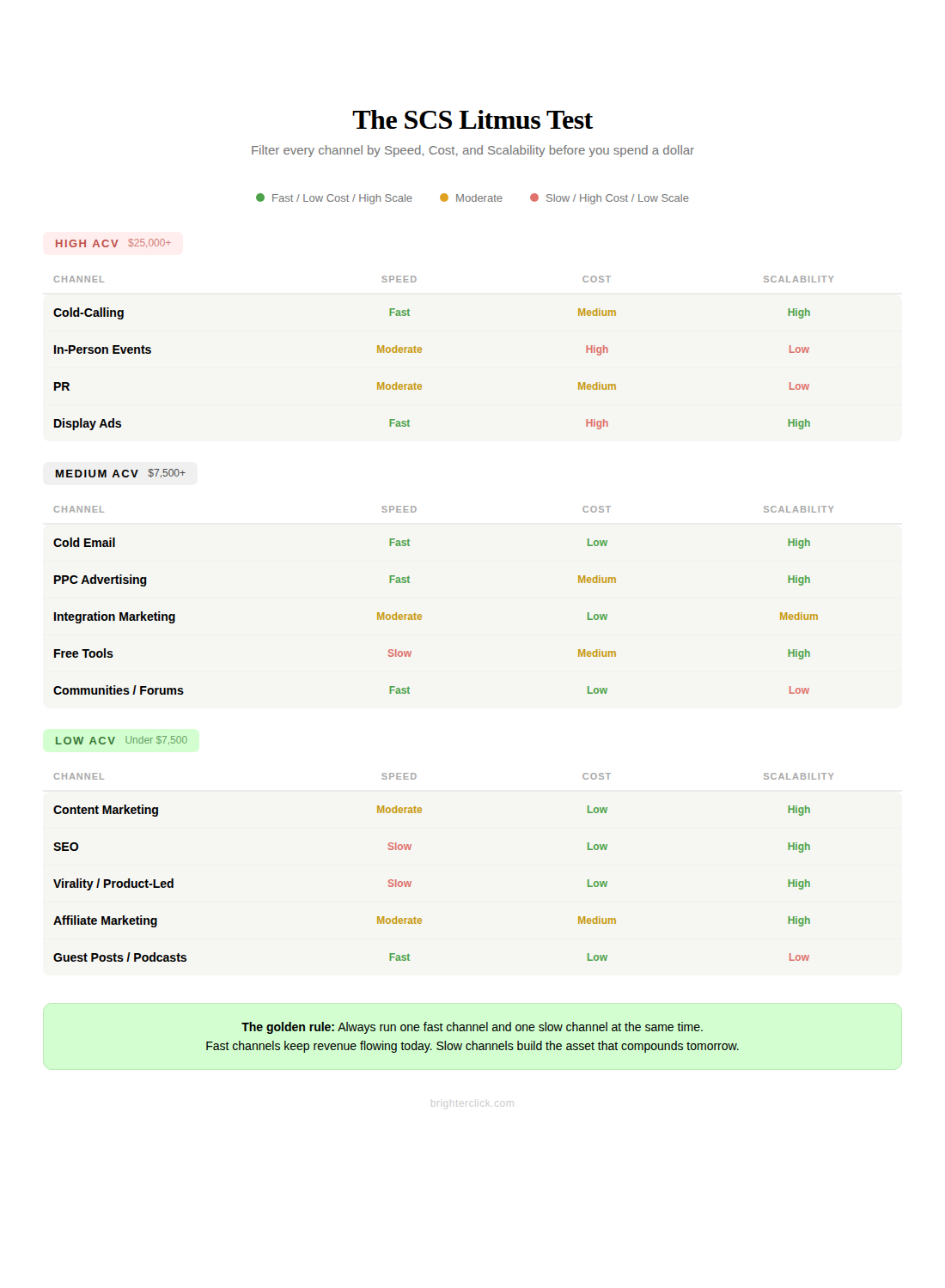
Run every channel through what we call the SCS Litmus Test before you spend a single dollar on it. SCS stands for Speed, Cost, and Scalability.
Speed. How long until this approach starts bringing in customers? Some channels work in weeks. Others take months or even years. In the early days, you need at least one fast channel to keep revenue growing while you build slower, more durable ones.
Cost. How much will this approach cost in real dollars? In the early days, think in terms of hard costs rather than your own time. As your revenue grows, more channels become affordable.
Scalability. Can you turn the dial up on this approach to reach more people? Some tactics, like posting on Product Hunt or answering questions on Quora, are one-time or time-intensive efforts that do not scale well. Others, like SEO and PPC, can grow steadily as you invest more.
Once you score a channel across all three dimensions, you get a quick read on whether it is worth testing right now, worth building toward for later, or not a fit at all.
Here is how the most common B2B SaaS marketing channels or strategies map to different price points.
If your ACV is $25,000 or more
You can afford high-cost channels:
- Cold-calling
- In-person events
- PR
- Display ads
- Offline advertising.
These make sense because a single closed deal can pay for months of effort.
If your ACV is around $7,500 or more
Your best options include
- Cold email
- PPC advertising
- Integration marketing
- Free tools (like a website grader or calculator(
- Community engagement in forums and groups.
If your ACV is lower
Focus on:
- Content marketing
- SEO/GEO
- Virality
- Affiliate marketing
- Partnerships
- Getting in front of other people's audiences through guest posts and podcast appearances.
And here is the rule that most founders break: always run one fast channel and one slow channel at the same time. If you are preparing for a product launch or just getting your first customers, lean heavier on fast channels to build early momentum. As you move past launch and into sustained growth, shift more weight toward slow channels that compound over time. But never run just one or the other. If you are only chasing fast wins (like cold outreach), you will always be scrambling for the next lead. If you are only investing in slow channels (like SEO), you will starve while you wait for results.
For the complete playbook on structuring paid media campaigns around pipeline instead of CPL, read our SaaS paid media strategy guide.
Action items:
- Write down your ACV. Use the tier breakdown above to identify which bucket you fall into (high, medium, or low ACV). This immediately narrows your channel options.
- List every marketing approach you have tried in the past 12 months. For each one, rate it on speed, cost, and scalability from 1 to 10 based on your actual experience.
- List three to five new marketing approaches from the tier that matches your ACV that you have not tried yet. These are your candidates for the next step.
- Identify which of your current or candidate channels is fast and which is slow. Make sure you have at least one of each. If you are only running slow channels, pick a fast one to add. If you are only running fast channels, pick a slow one to start building.
Step 5: Rank Your Options with a Weighted Scorecard
You have a shortlist of channels that passed the SCS Litmus Test. Now you need to figure out which ones to try first. Because if you try all of them at once, you will do all of them badly.
This is where founders make their most expensive mistake. They spread their budget and attention across six or seven channels, give each one a half-hearted effort for a few weeks, and then conclude that "marketing does not work for us."
Marketing works. Doing seven things poorly does not.
Use a weighted scorecard to force a ranking. Open a spreadsheet and list your candidate channels. Then score each one from 1 to 10 on three dimensions.
Impact: If this approach works, how big will the result be? A channel that could bring in hundreds of qualified leads scores high. One that might bring a handful scores low.
Confidence: How likely is this approach to succeed? If you have seen competitors thrive on this channel, or if you have data suggesting it will work, score it high. If it is a shot in the dark, score it low.
Ease: How easy is this to set up and run? A channel you can launch this week scores high. One that requires months of preparation or new hires scores low.
Multiply the three scores together, or average them. Either way, you get a ranked list of marketing approaches ordered by expected return on effort.
Start with the top one or two. Run them as experiments. Measure the results. Then use what you learned to update your scores and try the next approach.
A few tips to get the most out of this process.
Keep a marketing changelog. Every time you make a change, whether it is a new ad campaign, updated website copy, or a different email sequence, log it with the date. At some point, you will notice a metric shift and need to figure out what caused it. The changelog makes that easy.
Measure actual cost per customer for each channel. Do not rely on gut feeling about what is working. Track how much each channel costs and how many paying customers it produces. Compare those results to your original scores and adjust.
Do not try too many things at once. This is one of the most common mistakes. SaaS companies have grown to seven and eight figures on just one or two marketing channels done well. Find what works and double down on it rather than spreading yourself thin across a dozen experiments.
Action items:
- Create a spreadsheet with four columns: Marketing Approach, Impact (1-10), Confidence (1-10), and Ease (1-10). Add a fifth column that multiplies the three scores together.
- Score every approach on your shortlist from Step 4. Be honest. If you are not confident about a channel, give it a low confidence score rather than inflating it.
- Pick the top two approaches from your ranked list. Commit to running both for at least 30 days before evaluating.
- Start a marketing changelog today. It can be as simple as a Google Sheet with two columns: Date and Change Made. Log everything, even small tweaks.
- Set up attribution tracking for the two channels you are about to test. At a minimum, use UTM parameters so you can see which channel is producing trial sign-ups and which is producing paying customers.
Step 6: Track What Matters with the Six Metric Health Check
Here is a harsh truth: most SaaS founders either track too many SaaS KPIs and drown in dashboards, or they track nothing and make decisions based on vibes.
Both will kill your business. Just at different speeds.
You need eight numbers. That is it. Two north stars and six supporting metrics. If you know these eight numbers and check them regularly, you will see problems before they become crises and opportunities before your competitors do.
Your two primary metrics are MRR (monthly recurring revenue) and month-over-month growth rate. These tell you how far you have come and how fast you are going. Look at them every week.
But MRR and growth rate are lagging indicators. By the time they change, something already happened weeks or months ago. To see problems (and opportunities) earlier, we recommend tracking six additional metrics. Three of them you want to keep as low as possible. Three of them you want to drive as high as possible.
Keep These Low
CAC (Cost to Acquire a Customer). This is the total cost of landing a new customer, including marketing, advertising, and sales costs, divided by the number of customers you acquired. For bootstrapped SaaS companies, aim for a payback period of two to six months. If it takes longer than that to recoup what you spent acquiring each customer, you will run into cash flow problems.
Sales Effort. This measures how much time and energy it takes to close a deal. Track the average number of days from first demo to close, and the number of calls or touchpoints needed. You can lower sales effort with self-serve sign-up options, one-call closes, and educating prospects before they get to a demo.
Churn. This is the percentage of customers who cancel their subscription each month. For most B2B SaaS businesses, you want gross revenue churn under 3% per month. Anything above 5% is a serious problem.
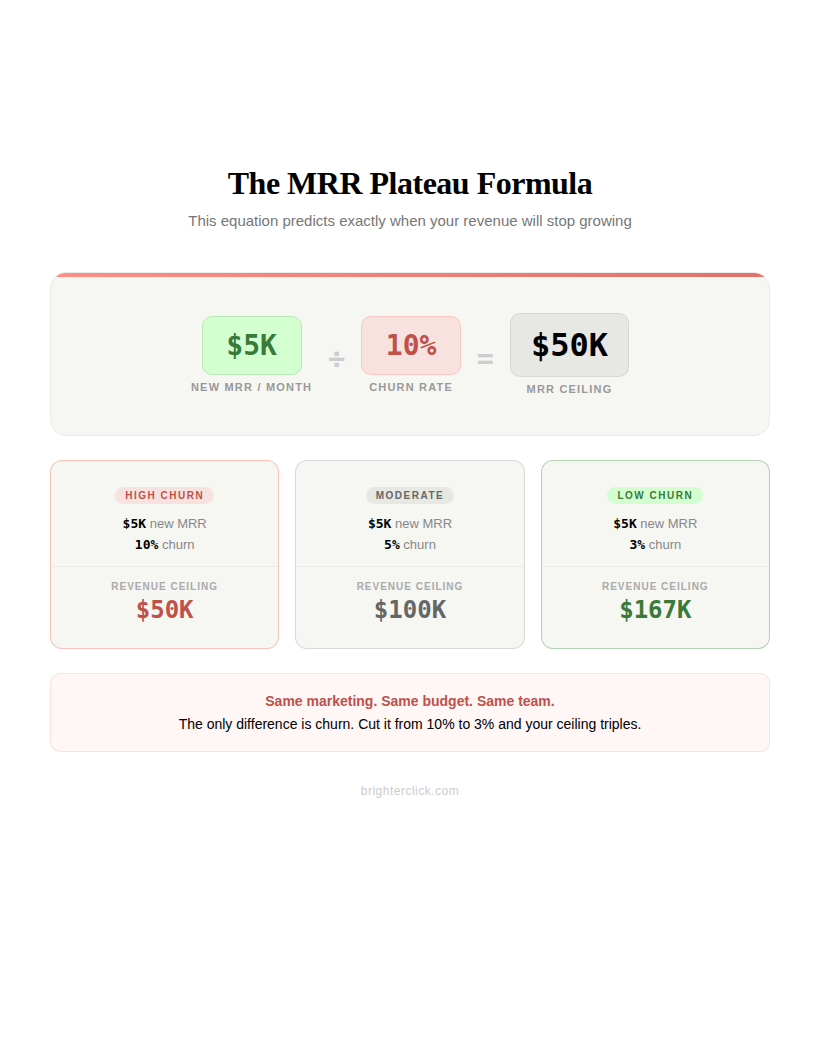
Here is why churn matters so much. There is a simple formula that predicts when your revenue will stop growing:
New MRR added per month divided by your churn rate equals your maximum MRR.
If you add $5,000 in new MRR each month and have a 10% churn rate, your revenue will plateau at $50,000. It does not matter how good your marketing is. Unless you bring churn down, you will hit a ceiling.
Push These High
ACV (Annual Contract Value). This is how much a customer pays you over a year. You can increase ACV by selling to businesses instead of consumers, segmenting your pricing tiers based on value, and raising prices. A useful rule of thumb: if nobody is complaining about your price, you are probably priced too low.
Expansion Revenue. This is when existing customers pay you more over time. It happens when you build your pricing around a value metric (like number of users, subscribers, or usage) so that customers automatically move into higher tiers as they get more value from your product. When expansion revenue is high enough, your revenue can grow even when you are not adding new customers. That is an incredibly powerful position to be in.
Referrals. Track how many new customers come from existing ones. Referred customers convert at higher rates and require less sales effort because they already trust your product. Ask happy customers for referrals around the 60 to 90 day mark. If your product has a natural sharing mechanism (like sending documents for signature or inviting team members), build that viral loop into the core experience.
Going Deeper on the Metrics That Matter Most
These six metrics will give you a clear picture of your marketing health, but there are a few deeper concepts worth understanding as you grow.
Many of these metrics are in tension with each other. Pushing one in the right direction can pull another in the wrong direction. For example, selling to larger companies increases your ACV, but it usually increases your sales effort and CAC too, because bigger deals take longer and cost more to close. There is no perfect balance. The goal is to understand the tradeoffs so you can make intentional decisions instead of being surprised.
Segment your churn. Do not just look at one number. An overall churn rate of 7% might sound bad. But when you break it down, you might find that your lowest pricing tier churns at 12% while your highest tier churns at 1%. That tells a very different story. The customers paying you the most are happy and sticking around. The ones paying the least are not a great fit.
There are three useful ways to segment churn.
First, segment by pricing tier. In almost every SaaS business, lower-paying customers churn faster and higher-paying customers are stickier. If your lowest tier is churning heavily, it does not necessarily mean you should cut it. It might be serving as an entry point that feeds upgrades to higher tiers. But you need the data to know.
Second, segment by marketing channel. This is more advanced but incredibly valuable. When you can see which acquisition channels produce long-term customers and which produce customers who cancel after two months, you can stop wasting money on channels that look good on a sign-up chart but hurt you on lifetime value.
Third, segment by time cohort. New customers almost always churn at a higher rate than customers who have been with you for six months or more. People use the first month or two as an extended trial. They signed up but have not fully set up their account yet. If you see heavy churn in the first 60 days, the problem is usually onboarding. People are not finding value fast enough. Churn after that window usually has a different cause, like a missing feature or a better competitor.
Watch out for vanity metrics. It is easy to get excited about numbers like website visitors, free sign-ups, or email list size. Those numbers sound impressive in a meeting, but they only matter in context. Fifty thousand website visitors per month means nothing if only 20 of them become paying customers. Always tie your top-of-funnel numbers back to revenue. The real question is: how many of those visitors, sign-ups, or subscribers are turning into people who pay you every month?
Net negative churn is the ultimate goal. When your expansion revenue (from upgrades and usage increases) is greater than the revenue you lose from cancellations, you have net negative churn. This means your existing customer base is growing in value every month even without adding a single new customer. It is rare, especially for early-stage companies. But it is worth designing your pricing and value metrics to make it possible, because it fundamentally changes the math of your business. Growth becomes much easier when your existing revenue is compounding instead of slowly leaking.
These six metrics, combined with MRR and growth rate, give you a complete picture of your SaaS marketing health. If something is off, you will see it in these numbers before it shows up in your revenue.
Action items:
- Set up a SaaS metrics dashboard if you do not have one. Tools like ProfitWell, ChartMogul, or Baremetrics connect to your payment processor and calculate most of these metrics automatically.
- Calculate your MRR plateau number right now. Take the new MRR you added last month and divide it by your gross churn rate. That number is where your revenue will flatten if nothing changes. Write it down. If it is lower than your goal, you know churn needs to come down or new MRR needs to go up.
- Segment your churn by pricing tier. Pull your cancellations from the last three months and group them by what plan they were on. If one tier is churning significantly faster than the others, dig into why. Are those customers a poor fit, or is that tier missing something they need?
- If you have enough data, segment churn by acquisition channel as well. Compare the lifetime value of customers from each source. You may find that one channel brings in lots of sign-ups that cancel quickly while another brings fewer sign-ups that stick around for years.
- Review your pricing page. Do you have a clear value metric that drives expansion revenue (like users, subscribers, or usage)? If your pricing tiers are based on features alone, explore whether adding a usage-based element could create natural upgrades and move you toward net negative churn.
- Add a "How did you hear about us?" field to your sign-up flow if you do not already have one. This is the simplest way to start tracking referrals and attributing growth to specific channels.
- Schedule a monthly metrics review. Block 30 minutes on your calendar to look at all eight numbers (MRR, growth rate, plus the six health check metrics). Trends over time are more useful than any single snapshot.
Step 7: Scale the Smart Way
This is the step where most founders lose their discipline. They find a channel that works, get excited, and immediately start chasing three more channels at the same time. Six months later, they have four mediocre channels instead of one great one.
Scaling is not about doing more things. It is about doing fewer things, harder.
Double down on what works. When you find a channel that delivers consistent, affordable customers, put more resources into it. Do not spread yourself across ten channels just because you can. The best SaaS companies often grow to millions in revenue on one or two channels done really well.
Keep running one fast and one slow channel. This principle does not go away at scale. You always want a mix of short-term pipeline and long-term compounding. If your SEO is starting to bring in organic traffic, great. But do not turn off the outbound or paid campaigns that are filling the funnel today.
Marketing gets easier as your brand develops. Once you become one of the two or three names people mention when they talk about your category, growth accelerates. People start coming to you. Partnerships become easier to close. Content gets shared more widely. But you have to earn that position through deliberate, consistent marketing over time. It does not happen on its own.
Action items:
- Look at your scorecard spreadsheet and your channel performance data. Identify your single best-performing channel. Write a plan to double your investment in it over the next 90 days, whether that means more budget, more content, or more outreach volume.
- Identify your weakest-performing channel. If it has not produced measurable results after 60 or more days of effort, cut it and reallocate those resources to what is working.
- Audit your attribution. Can you trace at least 75% of new customers back to a specific channel? If not, add UTM tracking, a "How did you hear about us?" question, or set a cookie on first visit to capture the referral source.
- Set a quarterly goal for your two north star metrics (MRR and month-over-month growth rate). Break it down into what each channel needs to contribute. This turns your strategy into a plan with numbers attached.
Understand the Strategy. Partner on the Execution.
The barrier to building SaaS products is gone. Anyone with a laptop and a weekend can ship one. That means the barrier to growing a SaaS product is higher than it has ever been. In 2026, your marketing strategy is not part of your competitive advantage. It is your competitive advantage.
Your job as a founder is to stay closer to your customer than anyone else, set the strategic direction with conviction, and track the metrics that tell you whether it is working. You do not have to do it all alone. And honestly, you should not try. The smartest founders pair their strategic ownership with execution partners who live and breathe SaaS marketing every day.
If you are looking for that kind of partner, check out our list of the top SaaS marketing agencies to find a team that fits your stage and budget.
Frequently Asked Questions About SaaS Marketing Strategy
What is a SaaS marketing strategy?
A SaaS marketing strategy is the plan a software company uses to acquire, convert, and retain customers who pay on a recurring basis. It is different from traditional marketing because the sale is never really "done." You are not selling a one-time product. You are selling a relationship. Every month, your customer decides whether to keep paying you or cancel.
That means your strategy has to cover the full lifecycle: how you attract the right people, how you get them to try your product, how you convert them to paid, and how you keep them long enough to make the economics work. It includes your funnel type, your channel mix, your positioning, your pricing, and the metrics you use to measure all of it. Most importantly, it has to be built on a deep understanding of your customer. Without that, everything else is guesswork dressed up as strategy.
How do agencies tailor marketing strategies for SaaS providers?
The best SaaS marketing agencies do not hand you a generic playbook and wish you luck. They start by understanding your specific business: your funnel type, your ACV, your customer profile, your churn rate, and where you are leaking revenue. Then they build an execution plan around the channels and tactics that actually fit your stage and price point.
For example, an agency working with a $50 per month self-serve product will focus heavily on inbound channels like SEO, content marketing, and paid acquisition with tight CAC targets. An agency working with a $50,000 ACV enterprise product will focus on outbound, ABM, and sales enablement content. The strategy looks completely different because the business model is completely different. If an agency pitches you the same approach they pitch every other client, that is a red flag. The value of a good agency is that they bring specialized execution to the strategy you have already set as a founder. They should be asking about your voice-of-customer data, your funnel metrics, and your growth targets before they ever talk about tactics.
How do you develop a SaaS marketing strategy?
Start with your customer, not your channels. The biggest mistake founders make is jumping straight to tactics ("Should we try LinkedIn ads? Should we start a blog?") before doing the foundational work.
A strong SaaS marketing strategy follows a sequence. First, build deep customer understanding through interviews, sales call recordings, and a voice-of-customer repository. Second, choose the funnel type that matches your pricing and market. Third, make sure the bottom of your funnel is healthy before you scale the top. Fourth, filter your channel options based on speed, cost, and scalability at your price point. Fifth, score and rank those options so you know where to start. Sixth, track the metrics that actually predict growth or stagnation. And seventh, scale by going deeper on what works instead of chasing new channels.
That is the exact framework this guide walks through. The key is doing these steps in order. Skipping straight to channels without understanding your customer or fixing your funnel is how founders waste months of effort and thousands of dollars on marketing that never converts.
How do you assess a SaaS marketing agency's data and AI strategy?
Ask them three questions and pay attention to how specific their answers are.
First, ask how they measure success. A good agency will talk about metrics that connect to revenue: CAC, trial-to-paid conversion, churn impact, and payback period. If they lead with vanity metrics like impressions, clicks, or "brand awareness," they are not thinking about your business the way you need them to.
Second, ask how they use data to make decisions. You want an agency that segments performance by channel, tests methodically, and adjusts based on what the numbers say. Ask them to walk you through a real example where data changed their approach for a client. If they cannot give you a specific story, their "data-driven" claim is just a slide in their pitch deck.
Third, ask how they use AI in their workflow. In 2026, every serious marketing team is using AI for content production, audience research, ad copy testing, and performance analysis. But there is a difference between an agency that uses AI to work faster and smarter and one that uses it as a crutch to produce generic, low-quality output at scale. Ask to see examples of their work. Ask how they quality-check AI-generated content. Ask whether AI is helping them deliver better results for clients or just helping them cut costs internally. The answer tells you whether their AI strategy benefits you or just benefits their margins.


